Introduction
Durian is a heavy-feeding perennial crop with distinct vegetative, flowering, fruiting and post-harvest recovery phases, and nutrient demand shifts markedly between them. A fertiliser programme built around a single fixed ratio applied year-round consistently underperforms one that is staged to the tree's growth cycle. This article sets out the general staging principles used across the industry and the confirmatory role of soil and leaf testing, and is explicit that the specific rates below are general starting points, not universal recommendations, since soil type, tree age, yield target and local extension guidance all affect the correct programme for a given block.
Note on sources: much of the granular, stage-by-stage rate guidance available for durian comes from industry and commercial agronomy sources rather than peer-reviewed trial publications. Where this is the case it is flagged explicitly below, consistent with Durian Doctor's editorial policy of distinguishing independent scientific evidence from commercial information.
Quick Summary
- Durian nutrient demand follows four broad stages: vegetative growth, pre-flowering, fruit development, and post-harvest recovery, each with a different optimal N:P:K emphasis.
- Nitrogen dominates during vegetative growth; phosphorus and potassium increase in relative importance from pre-flowering through fruit development.
- Potassium is the priority nutrient during fruit development, supporting fruit size, flesh quality and shell strength.
- Soil and leaf testing, not a fixed calendar alone, should confirm and calibrate the programme for each block.
Nutrient Demand by Growth Stage
| Stage | Nutrient Emphasis | General Rationale |
| Vegetative growth (young trees, post-harvest flush) |
Higher nitrogen, balanced P and K |
Supports canopy and root development; young trees (roughly years 1–3) typically receive a balanced NPK on a 6–8 week cycle to encourage establishment |
| Pre-flowering | Reduced nitrogen; increased phosphorus and potassium | Excess nitrogen at this stage favours vegetative growth over flower bud initiation; P and K support flower development |
| Fruit development | Potassium-dominant, with continued calcium and boron attention | Potassium is consistently identified as the priority nutrient for fruit size, sweetness and shell strength during this stage; calcium and boron support cell wall integrity (see the Nutrient Disorders article) |
| Post-harvest recovery | Balanced to nitrogen-leaning NPK, applied promptly after harvest and pruning | Trees need to replenish reserves and rebuild canopy before the next flowering cycle |
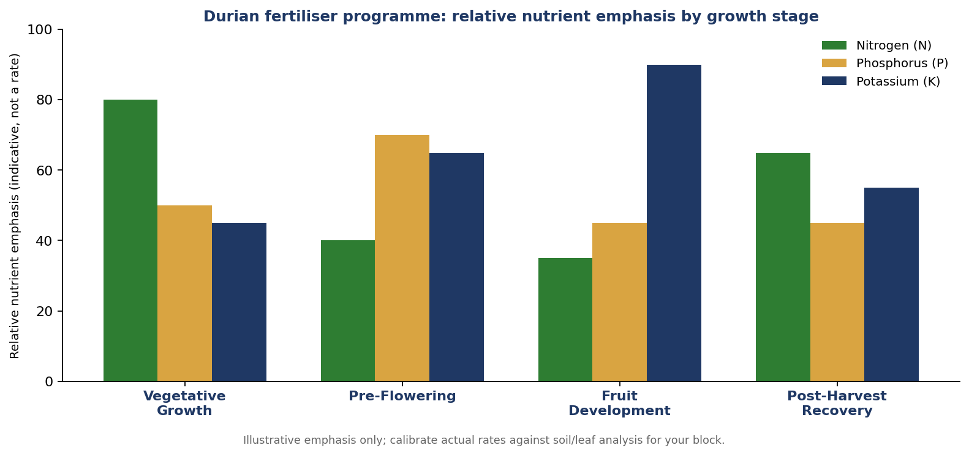
Figure 1. Durian fertiliser scheduling infographic across the four growth stages.
ALT text: Bar chart showing relative nitrogen, phosphorus and potassium emphasis across vegetative, pre-flowering, fruiting and post-harvest stages
Source: Original infographic created in-house from the staged programme described in this article; illustrative emphasis, not a rate recommendation.
Indicative Rates (General Starting Point Only)
Regional agronomic guidance circulated by Southeast Asian extension and industry sources commonly references complete fertiliser blends such as 15:15:15 or 16:16:16 immediately after post-harvest pruning, shifting toward a potassium-weighted blend (for example, ratios in the range of 12:12:17 or similar, with added magnesium) applied roughly 60 days after flowering opens to support fruit development, followed by a straight potassium application 30 to 45 days before expected fruit ripening. These figures are indicative starting points only; actual rate and ratio must be calibrated against your own soil test, tree vigour, crop load and the product label of whatever fertiliser is used in your market.
Application Methods
- Soil (granular) application: the primary method for base nutrition, applied at the drip line to encourage lateral root uptake, timed to the growth-stage schedule above.
- Foliar feeding: used for rapid correction of visible deficiencies, particularly micronutrients such as boron, zinc and magnesium, and for fast-acting supplementation during flowering and early fruit development when root uptake alone may not meet peak demand.
- Fertigation: where irrigation infrastructure allows, delivering soluble nutrients through the irrigation system enables more frequent, smaller applications matched to tree demand, particularly useful for potassium delivery through the fruit development window.
Leaf and Soil Analysis
Visual symptoms of nutrient deficiency typically appear after yield or fruit quality has already been affected (see the Nutrient Disorders article), which is why leaf and soil analysis, not calendar application alone, should anchor a durian fertiliser programme. Leaf sampling should be done at a consistent leaf age each season, since nutrient concentrations shift as leaves mature, and results should be interpreted against an appropriate durian leaf-nutrient sufficiency range rather than generic fruit-crop standards where such a range is available.
Practical Farm Checklist
| Check | Frequency |
| Apply post-harvest recovery fertiliser after pruning | Immediately following harvest |
| Reduce nitrogen, increase P and K ahead of flowering | Pre-flowering window |
| Apply potassium-weighted fertiliser through fruit development | From fruit set through pre-ripening |
| Leaf sampling for nutrient analysis | Annually, at a consistent leaf age |
| Soil testing | Every 1–2 years, or when establishing a new block |
Key Takeaways
- Stage the fertiliser programme to the tree's vegetative, pre-flowering, fruiting and post-harvest cycle rather than applying a fixed blend year-round.
- Potassium is the priority nutrient during fruit development; nitrogen should be moderated at this stage.
- Leaf and soil analysis, not visual symptoms or a fixed calendar alone, should calibrate rates for each block.
- Treat any specific rate figures as a starting point to be adjusted against your own soil test, tree vigour and product label.
Frequently Asked Questions
What NPK ratio is best for young durian trees?
Young trees in the establishment phase are typically given a balanced NPK blend, commonly cited in the range of 15:15:15 to 20:10:10 depending on soil nitrogen status, applied on a roughly 6 to 8 week cycle to support canopy and root development. Confirm against a soil test for your specific block.
Why does potassium matter so much during fruit development?
Potassium is consistently identified across fruit-crop agronomy as the priority nutrient for fruit size, sugar development and shell/husk strength, which is why fertiliser programmes shift toward a potassium-weighted blend from fruit set through pre-ripening.
How often should I apply fertiliser to a mature durian tree?
Application frequency depends on the method: granular soil applications are typically staged around four key points in the annual cycle (post-harvest, pre-flowering, fruit development, and a pre-ripening potassium boost), while foliar and fertigation applications can be more frequent and are used for fine-tuning and rapid correction.
Is foliar feeding a replacement for soil fertilisation in durian?
No. Foliar feeding is best used to complement soil-applied fertiliser, particularly for fast-acting micronutrient correction and during peak-demand periods like flowering, rather than as a full replacement for a soil nutrition programme.
How do I know if my fertiliser programme is actually working?
Leaf and soil analysis provide an objective check, since visual symptoms typically only appear after yield or fruit quality has already been affected. Track results against a durian-specific leaf nutrient sufficiency range where available.
References
CompleteGrow. (2025). Best fertilizer for durian trees: Feeding guide for healthy growth and fruit. [Industry/commercial horticultural guide].
Durian Info. (n.d.). Durian: Crop production cycle and orchard management practices. [Regional extension-derived grower guide, Philippines].
Haifa Group. (n.d.). Durian fertilizers & crop guide. [Commercial agronomy crop guide].
MASL Biotech. (2026). Durian fertilizer calendar: Seasonal nutrient management for maximum yield. [Commercial agronomy guide].