Introduction
Between fruit set and harvest, durian fruit passes through distinct physiological phases, each with its own risks for the grower: immature fruit drop early on, flesh formation and rapid growth through the middle of the period, and physiological disorders that typically emerge from around ten weeks after fruit set. Understanding this timeline helps growers target interventions, thinning, nutrition, canopy management, at the stage where they will actually make a difference.
Quick Summary
- Immature fruit drop is concentrated early: in a recent Musang King study, 35 percent of total immature fruit drop occurred within the first 14 days after fruit set.
- Flesh formation begins around 42 days after fruit set and reaches maximum growth rate by around 56 days in the same study.
- Physiological disorders, hardened flesh, aril tip burn, flesh discoloration, are first observed around 70 days after fruit set and increase in incidence through to harvest.
- These disorders are not caused by pests, disease or mechanical damage; they are physiological responses to conditions such as water supply, nutrition and tree health.
The Fruit Development Timeline
| Phase | Approximate Timing (Days After Fruit Set) | Key Events |
| Early fruit set / immature drop risk | 0–14 days | Highest concentration of immature fruit drop; ovary either continues developing (fertilised) or aborts (unfertilised) |
| Rapid growth | Roughly 28–70 days | Flesh begins forming around day 42, reaching maximum growth rate by around day 56 |
| Onset of physiological disorder risk | From approximately 70 days | Hardened flesh and discoloration first observed; incidence increases toward harvest |
| Ripening | Roughly 70–90 days, variety dependent | Fruit approaches harvest maturity; ethylene-driven softening begins (see the Harvesting article for maturity indicators) |
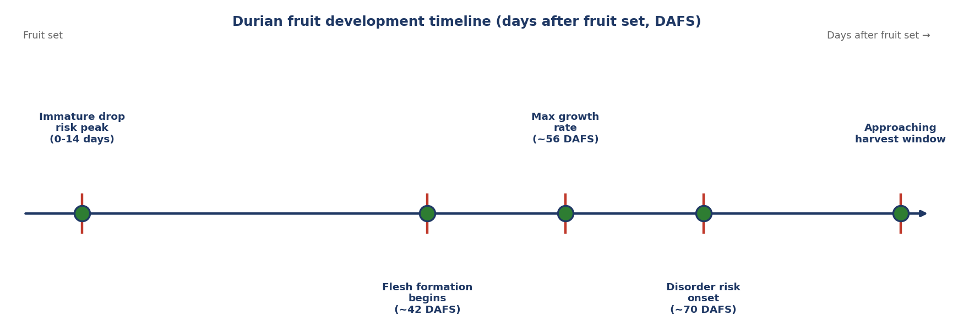
Figure 1. Durian fruit development timeline from fruit set through to the approaching harvest window.
ALT text: Timeline diagram showing durian fruit development stages from fruit set to ripening with key milestones
Source: Original diagram created in-house based on cited fruit development research (Nguyen et al., 2025).
Immature Fruit Drop
Fruit drop in the first two weeks after fruit set is a normal, expected physiological process, not necessarily a management failure. In a detailed phenological study of Musang King durian in Vietnam, 35 percent of total immature fruit drop occurred within this initial 14-day window, consistent with the general pattern where inadequately fertilised or weaker-set fruit are naturally shed as the tree allocates resources toward fruit with the best development potential.
Because this early drop is largely physiological rather than pathological, management focus at this stage is on supporting good pollination outcomes (see the Flowering Management article) rather than attempting to prevent all drop, and on appropriately timed thinning of the fruit that does persist.
Fruit Thinning and Bagging
Because durian trees typically set more fruit than can develop to full commercial size and quality, thinning excess or poorly positioned fruit early in the rapid-growth phase concentrates the tree's carbohydrate and nutrient resources on the remaining fruit, supporting more even sizing and reducing the incidence of some later-stage disorders.
Fruit bagging, in addition to its pest-management role (see the Durian Pests article), can also support more uniform fruit development by reducing direct sun exposure late in development, since overexposure to sunlight has been linked to fruit burning and canopy shading is recommended as a complementary practice.
Physiological Disorders During Fruit Development
Three physiological disorders are consistently reported in the durian literature: hardened flesh, aril tip burn, and flesh discoloration, alongside a related condition sometimes described separately as uneven fruit ripening, characterised by a hardened, leathery, whitish and largely tasteless aril. These disorders typically show no external symptom on the husk and are identified only once the ripe fruit is opened, which is what makes them commercially costly, since affected fruit reach market before the defect is visible.
These conditions are explicitly not caused by pathogens, insect pests or mechanical damage; they are physiological responses to unfavourable growing conditions, tree health, water supply, and nutritional status, particularly potassium and calcium balance during fruit development (see the Nutrient Disorders article). A recent Vietnamese field trial found that combining organic manure amendment with foliar fertilisation reduced physiological disorder rates and improved soil health compared with an unamended control, indicating that soil and nutrient management can meaningfully influence disorder incidence.
Separately, extension-reported field trial work in the Philippines found that mulching significantly reduced the incidence of uneven fruit ripening and wet core, consistent with the role of consistent soil moisture and root-zone conditions in disorder prevention.
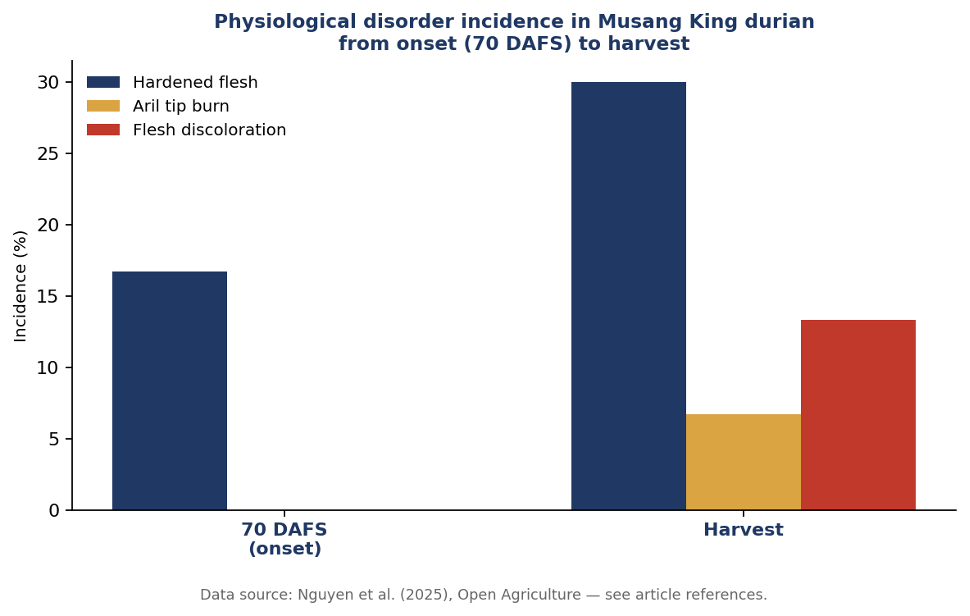
Figure 2. Progression of physiological disorder incidence from onset (70 DAFS) to harvest in Musang King durian.
ALT text: Bar chart showing increasing incidence of hardened flesh, tip burn and discoloration from 70 days after fruit set to harvest
Source: Original chart created in-house from data reported in Nguyen et al. (2025), Open Agriculture.
Differential Diagnosis: Physiological Disorder vs. Other Causes
- Physiological disorders show no external husk symptom; if there is a visible lesion, canker or borer frass on the husk, investigate disease or pest causes instead (see the Diseases and Pests articles).
- Fruit cracking with a clean split is more likely linked to calcium/boron/water-supply imbalance (see the Nutrient Disorders article) than to a pathogen.
- Since disorders are only visible once fruit is opened, a reliable orchard-level pattern (recurring in certain blocks, seasons or trees) is a stronger diagnostic signal than any single fruit.
Practical Farm Checklist
| Check | Timing |
| Monitor and record immature fruit drop pattern | 0–14 days after fruit set |
| Thin excess or poorly positioned fruit |
Early rapid growth phase |
| Maintain consistent soil moisture / apply mulch | Ongoing through fruit development |
| Review potassium/calcium nutrition programme | Pre-flowering through fruit development (see Fertiliser Programme article) |
| Sample-cut a small number of fruit before harvest to check for disorder incidence | Approaching harvest, per block |
Key Takeaways
- Most immature fruit drop is a normal physiological process concentrated in the first two weeks after fruit set.
- Flesh formation and rapid fruit growth occur mainly between roughly six and ten weeks after fruit set.
- Physiological disorders emerge from around ten weeks after fruit set and are linked to nutrition, water supply and tree health rather than pests or disease.
- Mulching and balanced organic/foliar nutrition have both been associated with reduced physiological disorder incidence in field research.
Frequently Asked Questions
Is it normal for durian fruit to drop after fruit set?
Yes, some immature fruit drop is a normal physiological process as the tree sheds inadequately fertilised or weaker fruit. Research on Musang King durian found 35 percent of total immature drop occurred within the first 14 days after fruit set.
When does durian flesh start forming?
In a detailed Musang King study, flesh formation began around 42 days after fruit set and reached its maximum growth rate by around 56 days.
What causes hardened flesh or tip burn in durian?
These physiological disorders are not caused by pests, disease or mechanical damage. They are linked to unfavourable growing conditions, particularly water supply, tree health and nutrient balance, especially potassium and calcium, during fruit development.
Can I tell if a fruit has a physiological disorder before harvest?
Generally no, these disorders typically show no external symptom on the husk and are only identifiable once the ripe fruit is opened, which is why orchard-level patterns and preventive management matter more than inspecting individual fruit.
Does mulching help prevent durian fruit disorders?
Field trial work reported in the Philippines found that mulching significantly reduced the incidence of uneven fruit ripening and wet core, consistent with the importance of stable soil moisture during fruit development.
References
Combining organic and foliar fertilization to enhance soil fertility and mitigate physiological disorders of durian (Durio zibethinus Murr.) fruit in the tropics. (2025). [Peer-reviewed field trial, Vietnamese Mekong Delta]. PubMed. https://pubmed.ncbi.nlm.nih.gov/40284073/
Durian Info. (n.d.). Uneven fruit ripening (UFR); wet core and tip burn in durian. [Extension-derived summary of Philippine Bureau of Plant Industry field trial work].
Nguyen, V. T., et al. (2025). Investigation of biological characteristics of fruit development and physiological disorders of Musang King durian (Durio zibethinus Murr.). Open Agriculture, 10(1). https://doi.org/10.1515/opag-2025-0422
Transcriptome analysis during fruit developmental stages in durian (Durio zibethinus Murr.) var. D24. (2022). [Peer-reviewed molecular study, Universiti Putra Malaysia]. PMC. https://www.ncbi.nlm.nih.gov/pmc/articles/PMC9830936/