Introduction
Nutrient disorders in durian rarely present as a single, unambiguous symptom. Deficiencies of different elements often overlap in appearance, and several of the fruit quality problems growers care about most, uneven ripening, tip burn, poor fruit fill, are linked to nutrient supply and timing rather than to any pest or pathogen. This article sets out how to read leaf and fruit symptoms against the specific nutrients involved, and how leaf analysis fits into a durian nutrition programme.
Quick Summary
- Nitrogen deficiency shows as uniform pale yellowing of mature leaves without defoliation; potassium deficiency starts with tip and margin yellowing on older leaves that progresses to necrosis.
- Calcium is immobile within the plant and must be supplied continuously to actively growing tissue, deficiency shows first in new growth and fruit tips, not old leaves.
- Calcium and boron work together in cell wall strength; imbalances in either are consistently linked to fruit cracking and uneven ripening in durian and related fruit crops.
- High potassium levels can suppress calcium uptake even when soil calcium is adequate, this potassium/calcium antagonism is well documented and matters for durian fruit-quality programmes.
Reading Leaf Symptoms by Nutrient
| Nutrient | Symptom Pattern | Leaf Age Affected |
| Nitrogen (N) | Uniform pale yellowing including veins; leaves generally do not drop | Mature leaves |
| Phosphorus (P) | Leaves noticeably smaller than well-fertilised trees; general growth reduction | Whole canopy |
| Potassium (K) | Yellowing starts at leaf tip and margin, progressing to browning/necrosis | Older leaves first |
| Calcium (Ca) | Stunted growth, small leaves, necrosis at leaf tips; poor fruit tip fill | New growth and fruit tissue first |
| Magnesium (Mg) | Interveinal yellowing starting near the midrib and spreading to margins; main veins stay green | Older leaves first |
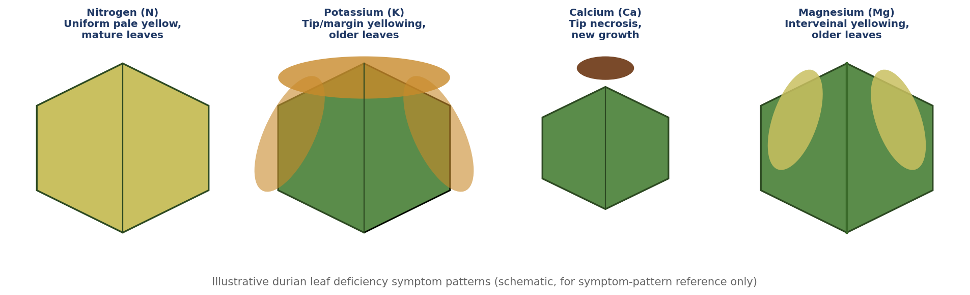
Figure 1. Schematic comparison of durian leaf deficiency symptom patterns across nitrogen, potassium, calcium and magnesium.
ALT text: Illustrated comparison of durian leaves showing different nutrient deficiency symptom patterns
Source: Durian Doctor original illustration, schematic reference for symptom pattern only.
Calcium, Boron and Fruit Quality Disorders
Calcium behaves differently from most other nutrients because it is essentially immobile once deposited in plant tissue and does not redistribute from older tissue to meet the needs of new growth or developing fruit. This means calcium must be available continuously through the fruiting period rather than supplied as a single application, and deficiency symptoms characteristically appear first in the youngest tissue and at the fruit tip.
Boron works alongside calcium in strengthening the cell wall, boron cross-links with cell wall pectin components and stabilises the calcium bridges that give fruit tissue its structural integrity. In fruit crops generally, calcium and boron deficiency or imbalance is consistently associated with cracking and dehiscence disorders, and in durian this relationship is widely reported by regional agronomy sources in connection with uneven ripening, wet core and tip burn, though a definitive causal mechanism specific to durian has not been firmly established in the peer-reviewed literature and should be treated as an area of ongoing investigation rather than settled fact.
A separate and well-documented interaction is the antagonism between potassium and calcium: elevated tissue potassium can interfere with calcium uptake and utilisation even where soil calcium supply is adequate, meaning that correcting a fruit-cracking problem sometimes requires re-balancing the potassium programme rather than simply adding more calcium.
Diagnosis: Confirming a Nutrient Cause
Visual symptoms narrow the likely nutrient involved but do not confirm it on their own, several deficiencies produce overlapping yellowing patterns, and waterlogged or compacted soil can produce nutrient-deficiency-like symptoms even when soil nutrient levels are adequate, because root uptake is impaired rather than nutrient supply.
Leaf analysis is the standard confirmatory tool in durian nutrition programmes. Sampling at a consistent leaf age, since nutrient concentrations change as leaves mature, and testing against an appropriate sufficiency range, is necessary for the result to be interpretable; this is why leaf-nutrient concentration standards specific to durian have been developed by regional research programmes.
Differential Diagnosis: Nutrient Disorder vs. Other Causes
- Nutrient-deficiency yellowing is typically diffuse and follows a consistent pattern by leaf age (see table above), whereas disease-related leaf spot appears as discrete lesions with defined margins.
- Waterlogging-related nutrient symptoms will correlate with drainage history and root health, not just fertiliser programme; check root condition before assuming a straightforward deficiency.
- Boron/calcium-linked fruit cracking presents as a clean split in the husk without the frass associated with borer damage (see the Durian Doctor Pests article) or the water-soaked lesion typical of Phytophthora fruit rot (see the Diseases article).
Management
- Base fertiliser programmes on leaf and/or soil analysis rather than a fixed calendar programme, since nutrient demand shifts with tree age and crop load (see the Durian Doctor Fertiliser Programme article for scheduling detail).
- Where calcium correction is needed, plan for continuous supply through the fruit development window rather than a single application, given calcium's immobility within the plant.
- Review potassium rates where fruit cracking or poor calcium response is observed, since excess potassium can suppress calcium uptake independently of soil calcium status.
- Consider foliar supplementation of calcium and boron during flowering and early fruit development where a deficiency or imbalance has been confirmed, and where the product can be recommended for use in durian farming in your market; always follow the current product label.
Prevention
- Establish a routine leaf-analysis schedule (see the Fertiliser Programme article) rather than relying only on visual symptoms, which typically appear after yield or quality has already been affected.
- Address drainage issues promptly, since impaired root function frequently presents as a nutrient deficiency even when soil nutrient status is adequate.
- Maintain balanced potassium programmes rather than maximising potassium alone for yield, given its documented antagonism with calcium.
Practical Farm Checklist
| Check | Frequency |
| Visual leaf scouting for yellowing pattern and leaf age affected | Monthly |
| Leaf sampling for nutrient analysis | Per season, at a consistent leaf age |
| Review fruit for cracking, tip burn or uneven ripening at harvest | Every harvest |
| Cross-check drainage where deficiency symptoms appear despite adequate fertilisation | As needed |
Key Takeaways
- Leaf age at symptom onset is one of the fastest ways to narrow down a suspected nutrient deficiency in durian.
- Calcium's immobility means it must be supplied continuously through fruiting, a single correction application is unlikely to resolve tip-related fruit disorders.
- Potassium and calcium interact antagonistically, review both together when diagnosing fruit-quality problems.
- Leaf analysis, not visual symptoms alone, should confirm a nutrient diagnosis before a fertiliser programme is changed.
Frequently Asked Questions
What causes durian leaf yellowing?
Leaf yellowing can result from nitrogen, potassium or magnesium deficiency, each with a distinct pattern by leaf age, or from waterlogging that impairs root nutrient uptake even when soil nutrients are adequate. Confirming the leaf-age pattern and checking drainage history helps narrow the cause.
Is calcium deficiency the main cause of durian fruit cracking?
Calcium and boron imbalance is widely associated with fruit cracking and uneven ripening in durian and other fruit crops, but a definitive, durian-specific causal mechanism has not been firmly established in peer-reviewed research. It should be treated as one contributing factor among several, alongside water stress and genetics.
Why is calcium harder to manage than other nutrients?
Calcium does not redistribute within the plant once deposited, so tissue formed earlier cannot supply calcium to new growth or fruit. This means calcium needs continuous availability through the fruiting period rather than a single application.
Can too much potassium cause a calcium deficiency?
Yes. Potassium and calcium are antagonistic in plant uptake, elevated tissue potassium can reduce calcium uptake and effectiveness even when soil calcium levels are adequate.
How often should I do leaf analysis for durian?
Leaf analysis is typically done at least once per season at a consistent leaf age, since nutrient concentrations change as leaves mature. See the Durian Doctor Fertiliser Programme article for scheduling guidance.
References
Agrobridge (Malaysia) Sdn Bhd. (2021). Durian: Beware the 'problem' nutrients during fruit development. Agrobridge Knowledge Articles.
Agrobridge (Malaysia) Sdn Bhd. (n.d.). Boron: A vital part of durian tree development. Agrobridge Knowledge Articles.
Chu Se Pepper. (2021). Expression of nutritional deficiency on durian leaves. [Extension summary, sourced from regional agricultural research].
Development of leaf nutrient concentration standards for durian. [Research record — full citation to be confirmed against the original publication before final QA, as the retrieved abstract text was co-indexed with an unrelated persimmon nutrition study].
Wu, L., et al. (2024). Calcium and boron foliar fertilizer to relieve cracking of 'Liuyuezao' pummelos. [Peer-reviewed study on Ca/B and fruit cracking mechanism, cited for cross-crop physiological principle, not durian-specific data].