Introduction
Weed management in durian is often treated as a secondary orchard task, but the underlying agronomic principles are well established across perennial tree-crop systems generally: weeds compete directly with young trees for water and nutrients, interfere with irrigation and fertiliser uptake, and can host pests and diseases that then move onto the crop. This article translates general orchard floor management research into practical guidance for durian, and is explicit about where the evidence is durian-specific versus general perennial-crop agronomy.
Quick Summary
- Weed competition has its greatest impact during the establishment years and during the critical growth window from flowering through early fruit development.
- A maintained vegetation-free or reduced-competition strip around the tree base is standard practice in young orchards; some tolerance for ground cover is acceptable once trees are established and root systems are deep.
- Mulching delivers weed suppression plus soil moisture retention and gradual organic matter improvement, but requires ongoing replenishment.
- Frequent shallow cultivation should be avoided close to the trunk, since it damages shallow feeder roots.
Why Weed Management Matters
Weeds compete with durian trees for water, nutrients and, in dense stands, light, and this competition is most damaging during the establishment phase when young trees have limited root systems, and again during flowering and early fruit set when nutrient and water demand peaks. Weeds also complicate irrigation and fertiliser placement, and can provide habitat for rodents and alternate hosts for certain pests and diseases.
Weed Management by Orchard Stage
| Orchard Stage | Recommended Approach | Rationale |
| Establishment (Year 1–2) | Maintain a clean, weed-competition-free zone around each tree; mulch rather than cultivate close to the trunk | Young trees have limited root systems and are most vulnerable to competition; shallow cultivation risks feeder root damage |
| Juvenile (Year 3–5) | Some tolerance for managed ground cover between rows; continue a maintained strip directly around the trunk | Deeper root systems compete more effectively; managed cover reduces erosion and supports beneficial soil biology |
| Mature/bearing | Managed cover crop or mown ground cover in row middles; weed-free or mulched strip maintained under canopy, prioritised through flowering and fruit set |
Nutrient and water demand peaks during flowering and fruit development; competition during this window has the greatest yield impact |
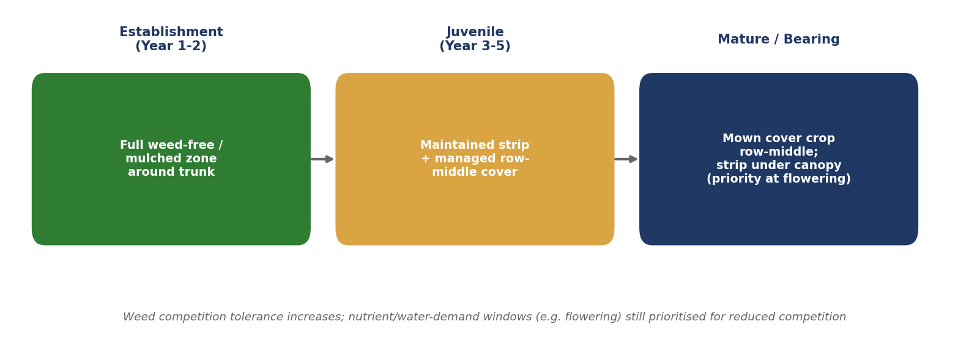
Figure 1. Weed-free zone and orchard floor management by durian tree stage.
ALT text: Diagram showing recommended weed-free zone and orchard floor management approach across establishment, juvenile and mature durian tree stages
Source: Durian Doctor original illustration.
Management Options
Durian growers generally have four weed management tools available, used in combination rather than in isolation.
- Mulching: organic mulch (wood chips, pruning residue, rice husk or similar locally available material) suppresses weed germination, conserves soil moisture, and gradually improves soil organic matter as it breaks down; most mulches provide roughly one to two seasons of suppression before replenishment is needed.
- Cover cropping: a managed, mown or low-growing cover crop in the alley/row middle reduces erosion, supports beneficial soil organisms, and can be cut and used as mulch material; cover crops are generally not recommended directly under the tree canopy of young trees because they compete for the same root zone.
- Mechanical cultivation: effective for weed knockdown but should be shallow and kept away from the trunk and root zone, since frequent or deep cultivation damages feeder roots and can reduce tree growth over time.
- Herbicide use: where a herbicide can be recommended for use in durian farming in your market, apply strictly according to the current product label, directing spray away from trunk and foliage contact, particularly on young trees where bark is more susceptible to damage.
Prevention and Long-Term Strategy
- Eliminate perennial weed and grass species before establishing a new block, since these are far harder to control once trees are in the ground.
- Correct any soil drainage or pH issues at establishment, well-drained, appropriately prepared ground supports faster tree root establishment and better competes with weeds.
- Avoid maintaining a fully bare, vegetation-free orchard floor across the whole property long-term, since this can reduce soil organic matter and beneficial soil biology over time; a managed, mown cover in row middles is generally preferable once trees are established.
- Rotate or vary weed control methods (mulch, cultivation, targeted herbicide) rather than relying on a single tactic season after season.
Practical Farm Checklist
| Check |
Frequency |
| Inspect trunk zone weed competition on young trees | Monthly during establishment |
| Replenish mulch layer | Annually or as it breaks down |
| Mow row-middle cover crop | As needed to prevent seeding/overgrowth |
| Review herbicide label and spray timing before application | Before each application |
Key Takeaways
- Weed competition matters most during establishment and again through flowering and early fruit set.
- Mulching and managed cover crops address weed suppression while also supporting soil health, unlike cultivation or herbicide alone.
- Avoid cultivation close to the trunk to protect shallow feeder roots.
- Any herbicide use must follow the current product label and local registration status for your market.
Frequently Asked Questions
When is weed control most important in a durian orchard?
Weed competition has the greatest impact during the establishment years, when young trees have limited root systems, and again through flowering and early fruit development, when nutrient and water demand peaks.
Can I use a cover crop directly under young durian trees?
Generally no. Cover crops are best kept in the row middle for young trees, since ground cover directly around the trunk competes with the tree's limited root system during establishment. A maintained, mulched strip is preferable at that stage.
Is mulching better than herbicide for durian orchards?
They serve different purposes and are often combined. Mulching suppresses weeds while also improving soil moisture retention and organic matter, but needs periodic replenishment. Herbicide, used strictly per label, offers faster knockdown but should be applied carefully to avoid contact with trunk or foliage.
Does cultivation harm durian tree roots?
Frequent or deep cultivation close to the trunk can damage shallow feeder roots and reduce tree growth over time. Where cultivation is used, keep it shallow and away from the immediate root zone.
Should I keep the whole orchard floor weed-free?
Not generally recommended long-term. A fully bare orchard floor can reduce soil organic matter and beneficial soil biology. A managed, mown cover crop in row middles combined with a maintained strip under the canopy is a more sustainable approach once trees are established.
References
Bradshaw, L. (2019). Best practices for non-chemical orchard weed management. Growing Produce / University of Vermont Extension.
Granatstein, D. (2016). Orchard floor management [Presentation]. Washington State University Center for Sustaining Agriculture and Natural Resources.
Intermountain Fruit. (n.d.). Orchard floor management systems. Utah State University Extension.
Stivers, L., Baugher, T., & Basedow, M. (2017). Integrated weed management: Weed scouting for fruit production. Penn State Extension.
Washington State University Tree Fruit Extension. (n.d.). Weed management. WSU Tree Fruit.